What Is The KMP External Codec libvlcjni.so CPU ARM64-v8a & How To Install It?
 By Ankita Tripathy
02 February, 2026
Technology
By Ankita Tripathy
02 February, 2026
Technology
If you have been hearing about KMP External Codec libvlcjni.so CPU ARM64-v8a and wondering whether you need it or not, you are not alone!
A codec is a hardware or software component that performs the function of encoding and decoding a data stream or signal.
It can be a piece of software that encodes and decodes media files such as songs and videos. For example, a media player like KMPlayer may use external codecs to play files that it does not support.
Among its powerful capabilities and efficient performance, this libvlcjni.so CPU ARM64-v8a has undeniably become a necessary element in upgrading the multimedia experience.
In simple terms, it is a set of functions that allows the decoding and encoding of different video formats on Android devices running ARM64-v8a architecture.
But do you need it? To find out that answer, keep reading till the end…
What Is The KMP External Codec libvlcjni.so CPU ARM64-v8a?

The libvlcjni.so file is an external codec that is used by KMPlayer (KMP) on Android to play high-quality or proprietary audio formats such as EAC3, DTS, and TrueHD. The arm64-v8a version is especially tailored for modern 64-bit Android devices.
The KMP External Codec libvlcjni.so is a library supporting ARM64-v8a architecture in CPU processing.
This codec is built to enable video and audio playback on ARM64-v8a devices that are typical in present-day smartphones, tablets, and other portable gadgets.
By using the KMP External Codec libvlcjni.so, developers can fine-tune their multimedia programs to fully leverage the processing potential of ARM64-v8a CPUs.
This brings about flawless and robust playback of HDTV videos and top-notch audio on ARM64-v8a devices.
The KMP External Codec libvlcjni.so collaborates with the libVLC media framework, thereby offering smooth integration and compatibility with the majority of media formats.
Thanks to its effective encoding and decoding methods, you need very little CPU usage. In turn, this results in higher performance and longer battery life of ARM64-v8a devices.
Features Of KMP External Codec libvlcjni.so CPU ARM64-v8a
The external libvlcjni.so CPU ARM64-v8a Codec presents a number of key features that make it a vital media playback component for ARM64-v8a devices:
- High-performance decoding.
- Support for multiple formats.
- Low memory footprint.
Benefits Of KMP External Codec libvlcjni.so CPU ARM64-v8a
Utilizing the libvlcjni.so external codec (most notably the ARM64-v8a variant) with KMPlayer opens the door to a handful of essential benefits for a new generation of Android devices, namely:
- Expanded format support.
- Performance optimization.
- Hardware acceleration.
- Battery efficiency.
How To Install KMP External Codec libvlcjni.so CPU ARM64-v8a?
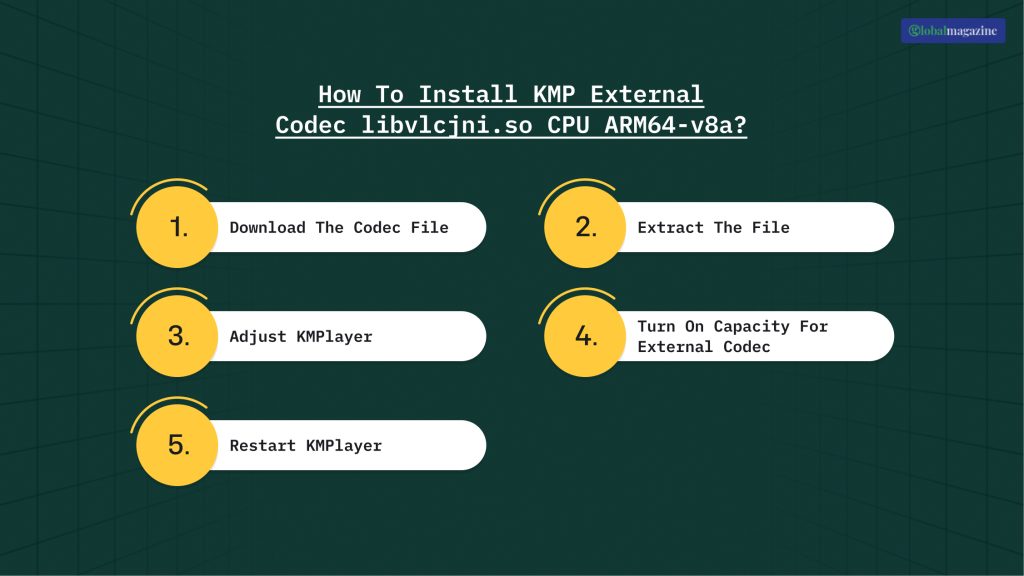
Here are the step sthat youneed to follow if you want to install the KMP External Codec libvlcjni.so CPU ARM64-v8a:
Step 1: Download The Codec File
Visit the official website and download the file from there. Double, check that you have the right version. The name of the file should be libvlcjni.so. It must correspond to your CPU: arm64-v8a. Make sure that the source is reliable.
Step 2: Extract The File
Open the folder with the help of the zip utility. Find the libvlcjni.so file inside. Put it into the Download folder. Not a customizable folder. The file should remain in the Download directory. This is the place where KMPlayer will search for it.
Step 3: Adjust KMPlayer
Run the KMPlayer. Go to Settings. In the General tab, you can open. This is the place where you can regulate the behavior of the player. The choices of external codecs are here. To keep it stable, do not change the unrelated settings.
Step 4: Turn On Capacity For External Codec
Locate the setting for the external codec. Flip it ON. Next, press the “Initialize App” button. This updates the player settings. At present, KMPlayer is aware of the new file.
Step 5: Restart KMPlayer
Exit and start KMPlayer again. Repeat this step for two or three times. Then, open your media file again. You will get the smooth effect of the playback.
What Are The libvlcjni.so Supported File Formats?
There are literally so many different types of formats that this external codec supports. Some of them are:
| Media Type | Format |
|---|---|
| Audio | eac3, RealAudio, AC3, DTS, WMA, MP3, LPCM, AAC, FLAC, ALAC |
| Video | H.264, H.265, WMV, Theora, MPEG-4, Cinepak, MJPEG, VP6, RealVideo, Cinepak, MJPEG |
Compatibility With Different Hardware Acceleration Technologies
Kmp External Codec libvlcjni.so CPU ARM64-v8a is a solution that can interact with several hardware acceleration technologies in ARM64-v8a devices.
Such a feature allows the codec to be very compatible with different devices and manufacturers, so it can play media smoothly, no matter what the hardware configuration is.
The library is capable of communicating with and taking resources from a GPU if it is used for video acceleration, or from hardware video decoders and other specialized hardware components. Thus, in this way, it helps achieve excellent performance and compatibility.
Kmp External Codec libvlcjni.so CPU ARM64-v8a can provide a great media playback experience on ARM64-v8a devices if it is enabled to utilize hardware acceleration.
Additionally, it can also be a kind of future-proof solution. This is because it will be able to capture and utilize changes in hardware technologies in order to deliver the best performance.
Here’s a look at compatibility:
| arm64-v8a | modern 64-bit smartphone |
| armeabi-v7a | old 32-bit Android device |
Who Should Get The KMP External Codec libvlcjni.so CPU ARM64-v8a?
The libvlcjni.so external codec is specifically needed by two types of users. Here’s what you need to know:
1. Users With Unsupported Audio/Video Formats
In case you get errors such as “EAC3 audio not supported” or “This media requires an external codec, ” the file hugging you is the one you need.
Due to licensing reasons, KMPlayer’s standard codecs sometimes do not support, or deliberately exclude, certain top-quality or proprietary formats. This pack brings support for:
- Audio: EAC3 (Dolby Digital Plus), DTS, DTS-HD, and TrueHD.
- Video: Advanced MKV features, some high, resolution 4K/8K encodings, and HDR tonemapping.
2. Owners Of Modern Android Devices (ARM64-v8a)
This particular release targets the arm64-v8a platform, and thus it supports almost all the mid-range and high-end smartphones and tablets nowadays.
- Performance Seekers: Accessing the native 64-bit library brings you hardware acceleration, i.e., the graphics processor is handling the video decoding instead of the main CPU.
- Battery Savers: It uses more efficient decoding algorithms specifically designed for your 64-bit chip. So, it is likely to consume less power during playback than standard software decoding.
Alternative Codec Options
If this file happens to be malfunctioning, you can always try a different version. These are some of the codec alternatives that may work:
- libvlcjni.so CPU armeabi-v7a: for older phones.
- libvlcjni.so x86_64: for emulator or PC.
Select the one that suits your system. Nevertheless, for ARM64 phones, use kmp external codec libvlcjni.so CPU arm64-v8a only.
Always keep in mind that the system or device will not be able to recognize an incorrect codec. Therefore, if you want to make it work, it is best that you always match your CPU architecture with the codec version.
Social Media:
The libvlcjni.so file is an external codec used by KMPlayer (KMP) on Android to support high-fidelity or proprietary audio formats like EAC3, DTS, and TrueHD. The arm64-v8a version is specifically designed for modern 64-bit Android devices.
Are you currently seeing an “EAC3 not supported” error message, and do you need help with that? Check out this link to know more!