What Is RTI Scheduler: Who Needs This & How Can It Help?
 By Ankita Tripathy
02 February, 2026
Finance
By Ankita Tripathy
02 February, 2026
Finance
The current fast-paced world, where time is a scarce resource, has seen the coming up of ‘gamechangers’ like the RTI Scheduler. And trust me, this has become handy not only for students but for professionals and the management as well.
Regardless of whether you are dealing with difficult schedules, handling intervention times, and/or multiple priorities, an RTI Scheduler can help.
With the help of live data and smart algorithms, this utility helps to manage resources efficiently, minimize idle time, and reach objectives accurately.
What Is An RTI Scheduler?
Struggling through never-ending email chains just to schedule an interview or sales call? Are candidates slipping away due to the delay and/or confusing nature of the process?
A scheduler for RTI can turn the tables and inject much-needed real-time clarity concerning the times and means of such conversations.
An RTI Scheduler is a software program created to handle optimization in scheduling processes in a real-time environment. It was first developed for educational purposes to handle scheduling interventions for students.
It has since been applicable in other fields such as corporate management. Additionally, it uses data-driven decision-making to schedule tasks.
How RTI Scheduler Helps In Your Work?
An RTI Scheduler is a tool that organizes education workflows and makes intervention and enrichment period scheduling easier and less tedious.
Such a scheduler changes an educational institution from simply using manual spreadsheets and paper hall passes to an automated, data-driven system.
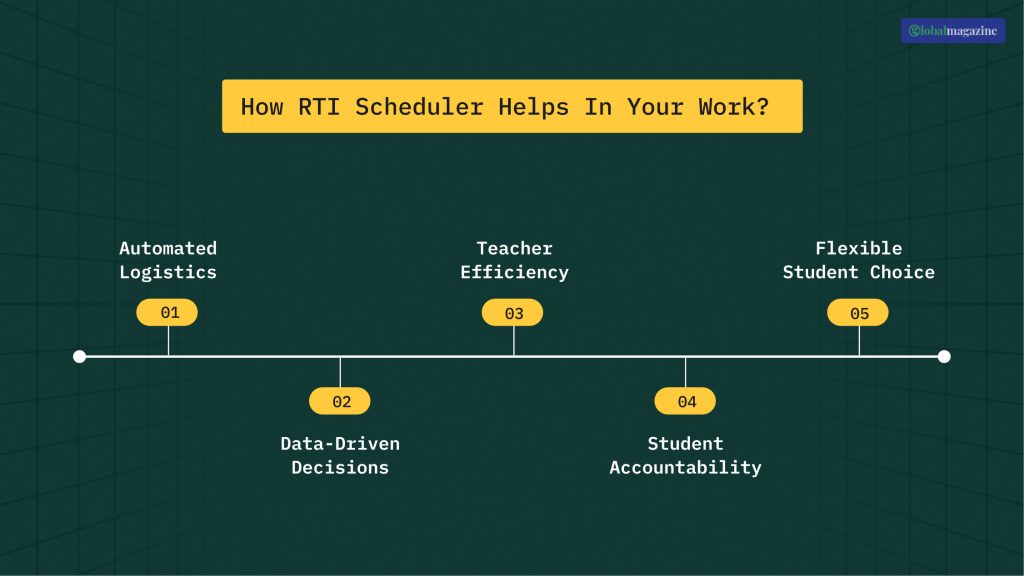
Here is what an RTI Scheduler can do for your work:
Automated Logistics:
It relieves the burden of manual coordination by using intelligent algorithms that match students to intervention groups based on their learning needs, hence no more double-booked schedules.
Data-Driven Decisions:
Apps such as RTI Scheduler and Minga connect with Student Information Systems (SIS) to get real-time data like grades or behavioral alerts that help the schools focus resources on the students in most need of support.
Teacher Efficiency:
Teachers have the ability to request certain students or make use of session templates to set up classes, saving them from the tedious administrative work of “chasing records”.
Student Accountability:
Automatically logging attendance and giving students real-time alerts through notifications are some of the ways the students’ movement to the right locations is tracked, thus minimizing no-shows.
Flexible Student Choice:
The learners who do not need any intervention can simply self-enroll in the activities of their choice, and the system will handle the rest. In this way, it results in strong student engagement but at the same time maintains school administration ’guardrails’.
How Can RTI Scheduler Help In Interviews?
Basically, an RTI Scheduler harmonizes calendars, availability, and communication channels so that both parties can book or change meetings in real time.
It enables interviewers to conduct interviews without the need for manual coordination between recruiters and candidates. In fact, it can reduce scheduling and related bottlenecks by up to 90%.
In the context of professional hiring, “RTI” stands for real-time, instant data syncing that ensures both parties see the most recent availability at all times.
- Candidate Self–Service: Candidates do not have to send multiple emails back and forth. Instead, they receive a secure link to check the hiring manager’s real-time availability and book their own slot.
- No-Show Reduction: Reminders are sent to candidates via automated multi-channel notifications (email and SMS). This, on average, lowers no-show rates by 65%.
- Time–Zone Intelligence: The scheduler identifies candidates’ locations automatically and converts available times to their time zone. Thus, there is no miscommunication in global hiring.
- Automated Rescheduling: Candidates can reschedule or cancel through the portal if a conflict occurs, without contacting the recruiter, who is then immediately notified of the change.
- Panel Coordination: In an interview where multiple stakeholders are involved, the system “juggles” several calendars simultaneously to find a convenient time for the entire panel.
Can The RTI Scheduler Maximize Efficiency?
Yes, it can have a positive impact on efficiency. Here’s how:
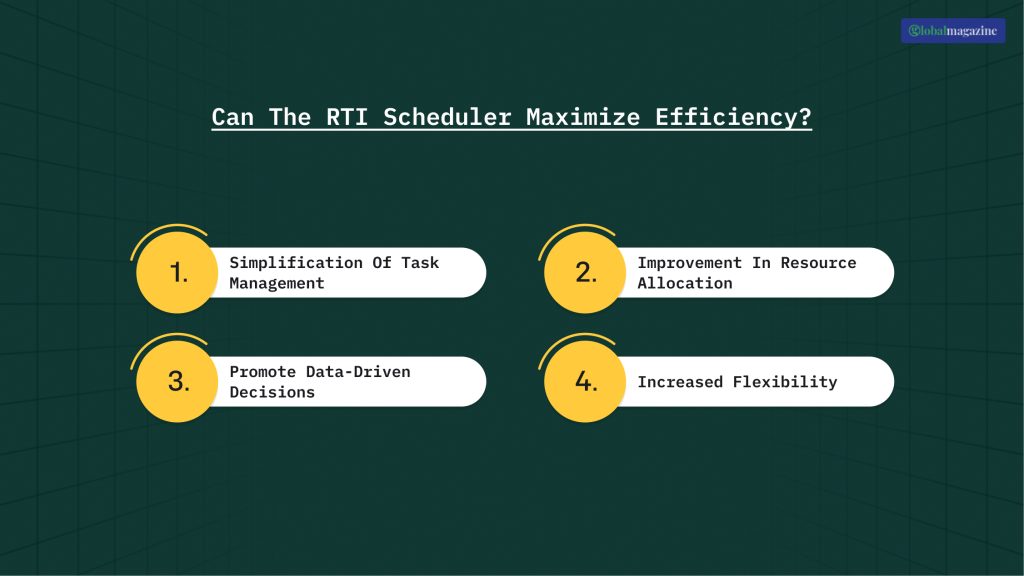
1. Simplification Of Task Management
Other chief advantages of an RTI Scheduler are the ease with which tasks can be oversimplified. Since the scheduler automates the scheduling process, no need exists to go through a set of manual coordination. It greatly reduces the chances of any potential error.
For example, schools can use the tool to allocate students to proper intervention groups with no scheduling overlap, which is a major concern mentioned by educators on the forums of Reddit.
2. Improvement In Resource Allocation
This implies that effective resource allocation is key to achieving maximum productivity. The RTI Scheduler matches resources—personnel, equipment, or time slots—to tasks or objectives in real time.
It is with this dynamism that organizations can adapt easily and respond to emerging priorities or unexpected challenges.
3. Promote Data-Driven Decisions
That is where its effectiveness lies: in the gathering of data for subsequent analysis. For instance, it allows users to identify bottlenecks by monitoring:
- Task completion rates.
- Resource utilization.
- Adherence to schedule.
In this way, they help to make informed decisions to optimize the processes further.
4. Increased Flexibility
Another strength of the RTI Scheduler is its flexibility. This could involve modifying the schedule due to unexpected events or individual preferences.
For students, this could mean personalized attention during intervention time. On the other hand, for professionals, this could mean the smooth integration of work and personal obligations.
Common Problems Of Using An RTI Scheduler?
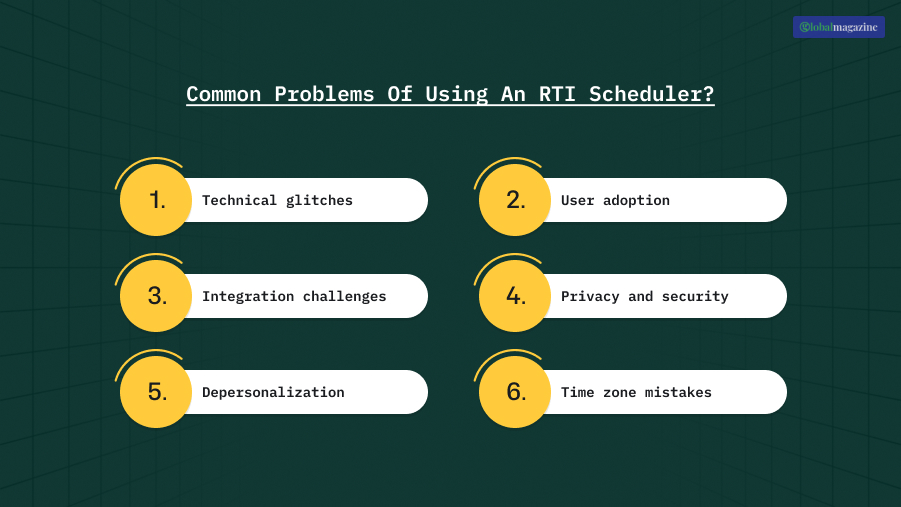
An RTI Scheduler implementation will help to improve workflows. Nevertheless, the effectiveness of such a system can be significantly compromised if it falls into one of the few typical mistakes.
Here is a brief guide on the major problems that can arise from using an RTI Scheduler:
- Technical glitches: Sometimes, the different parts of the platform fail to sync or to send notifications.
- User adoption: Either employees or candidates may be reluctant to use product features.
- Integration challenges: You will do extra manual work if the scheduler tool doesn’t work together with your ATS/CRM.
- Privacy and security: Data associated with candidates and calendars is very confidential and protecting it can be problematic.
- Depersonalization: People may not be comfortable with receiving an automated message, as it may seem impersonal or robotic.
- Time zone mistakes: If a candidate is in a time zone other than yours, they may misunderstand the event schedule.
Major Use Cases Of An RTI Scheduler
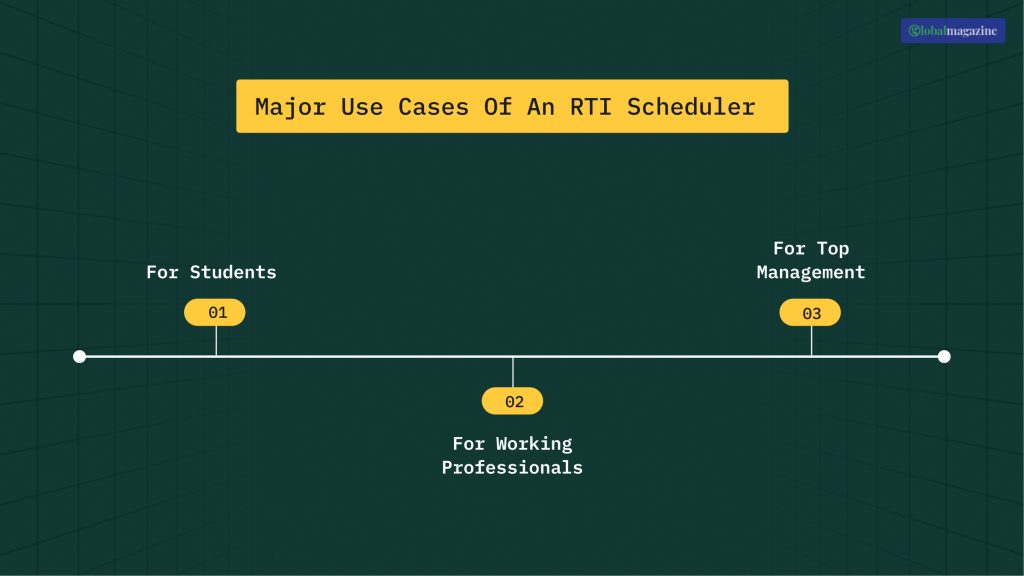
Here are some of the major ways in which an RTI Scheduler can work:
1. For Students
On top of academic pressures and extracurriculars, students often find it difficult to manage their time effectively.
An RTI Scheduler would be a great tool to help students decide on their priorities, as it would generate personalized study schedules concentrating on weaker areas while still allowing time for recreational activities.
Schools that have incorporated the RTI Scheduler in their curriculum have noticed drastic improvements in their students’ performances. This is because the students get their targeted interventions precisely in the ‘Power Hour’ or ‘WIN time’ classes.
2. For Working Professionals
At the workplace, an RTI Scheduler can be utilized to circulate work among the employees based on their strengths, besides managing the deadlines, and tracking the progress of teams.
Its automation capabilities are a huge time-saver, since they eliminate the monotonous tasks of sending reminders or updating calendars manually.
As an example, it will suffice if the marketing manager uses the RTI Scheduler to synchronize the marketing activities with the different departments so that the deadline can be met without stress.
Moreover, the reporting functionalities of the tools will give the marketing manager an idea of the team’s overall performance and, at the same time, pinpoint the weaknesses.
3. For Top Management
Executives at the helm of the organizations are often confronted with the dilemma of dividing their time between strategic planning and running the businesses.
With the RTI Scheduler, top management can easily coordinate schedules across different departments.
Additionally, they can have an efficient way to monitor activities and receive real-time updates on essential performance metrics (KPIs).
When the scheduling tool is connected with other software such as CRM or project management, executives are able to have an overall picture of the company’s performance.
Such a holistic view enables them to make informed decisions and hence be one step ahead of any risk that could potentially harm the company.