What Is A Proxy Server & How It Works For Your Business?
 By Ankita Tripathy
08 January, 2026
Internet
Last Updated on: January 14th, 2026
By Ankita Tripathy
08 January, 2026
Internet
Last Updated on: January 14th, 2026

Topic of the day: fungsi proxy server!
A proxy server is like a middleman between you and the internet. When you ask for something online, the proxy grabs that request and sends it on to the right place. Once it gets the answer, it shoots it back to you.
Now, how does that help businesses? Well, proxy servers are pretty important for keeping networks secure and organized.
To know more, keep reading till the end…
What Is A Proxy Server?
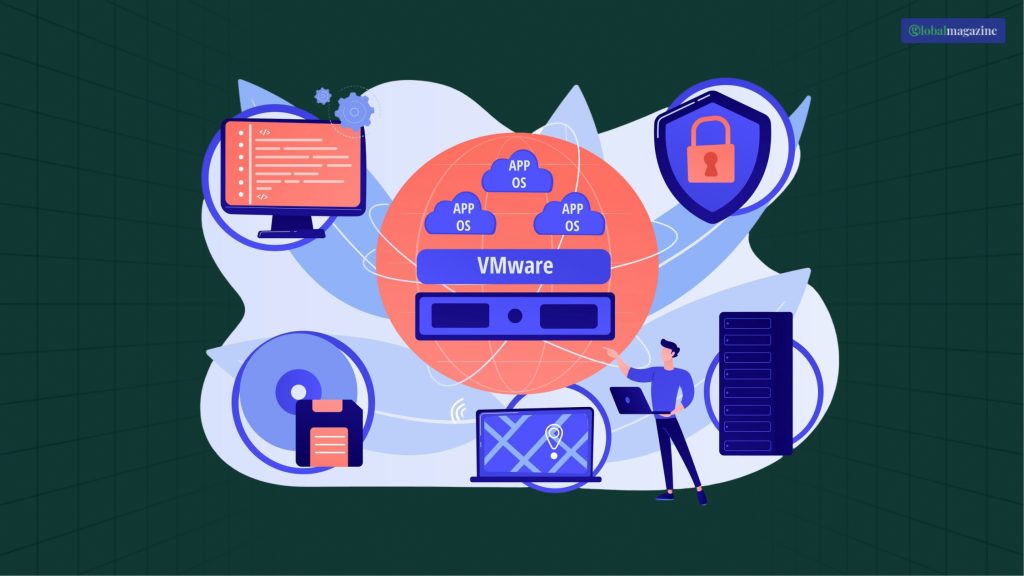
A proxy server is basically a system or a router that creates a link between users and the internet. That is why it also keeps hackers away from the private network.
It is primarily called an “intermediary” server. This is because it stands between end-users and the web pages they access online.
Every time a computer is online, it has to use an IP address. This is very much like the street address of your home. That’s because it tells incoming data where to go and marks outgoing data with a return address for other devices to recognize.
In fact, a proxy server is a computer online that is equipped with its own IP address. Fortinet explains it as the “gateway to the internet – acting as a middleman between your device and the web.”
How Does A Proxy Server Work?
By having a separate IP address of its own, a proxy server is able to function as an intermediary between a computer and the internet.
Your computer is aware of this address, and when you make a request on the internet, the proxy is the one that is sent the request.
The proxy then obtains the response from the web server and sends the data of the web page back to your computer’s browser, such as:
- Safari.
- Chrome.
- Microsoft Edge.
- Firefox.
Who Needs A Proxy Server?
There are a few people who use proxies for non-public purposes. These mostly include hiding their location while watching movies on the internet. However, for a company or business, they may be used to perform numerous key tasks. Some of these include the following:
- Improve safety and security
- Secure the internet activities of the employees.
- Prevent crashes by balancing internet traffic.
- Save bandwidth by using cached files.
Fungsi Proxy Server: Types Of Proxy Servers
Here are some of the most common types of proxy servers that you should know about:
- Forward Proxy
- Reverse Proxy
- Transparent Proxy
- Anonymous Proxy
- High Anonymity (Elite) Proxy
- Distorting Proxy
- Datacenter Proxies
- Residential Proxies
- Mobile Proxies
- SOCKS Proxy
- HTTP Proxy
- SSL Proxy
Fungsi Proxy Server: Core Functions Explained
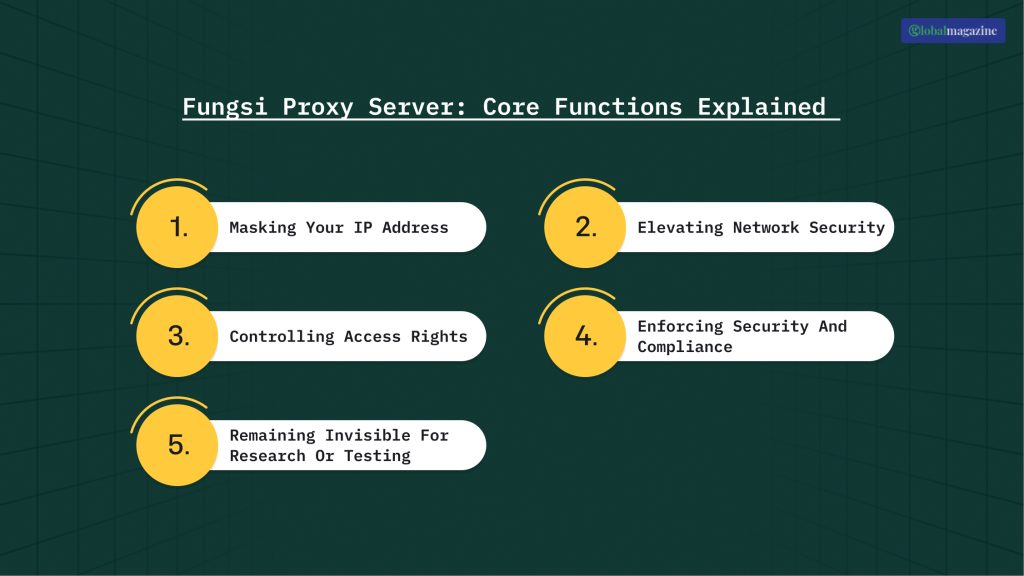
Now that you have the gist of fungsi proxy server, you might be wondering: what exactly does a proxy server do in the bigger context? Here are the key takeaways:
1. Masking Your IP Address
This is, in fact, the first thing that pops in most people’s minds. A proxy server masks your actual IP address. When you access a website through a proxy, the site only sees the address of the proxy it doesn’t see yours.
Through this, your identity remains concealed and it becomes more difficult for anyone to track you or break into your system.
For enterprises, it’s a major part of safeguarding their internal systems from unauthorized people.
2. Elevating Network Security
A proxy is an excellent cybersecurity protective barrier. Since all requests and responses take the route through them, they have the capacity to do the following things:
- Shut down access to suspicious sites.
- Detect strange behavior.
- Identify anything that looks like a cyberattack.
For instance, these could be phishing attempts, malware installations, or even the use of stolen credentials.
Hence, proxies are not only a decor of tech they have an essential role in constructing a secure and dependable network.
3. Controlling Access Rights
This is the reason network administrators adore proxies. They can determine who can access what online, impose restrictions on visiting certain websites or limiting times, and even grant permissions depending on the department or job role.
It helps everyone to be more productive, lowers risks, and ensures that the company internet is used for the right purposes.
4. Enforcing Security And Compliance
Proxies not only filter traffic, but they log it as well. They monitor what users do and keep records for audits.
This is beneficial to companies as it enables them to comply with data protection regulations such as GDPR or any other local regulations.
So, if set up properly, proxies are indispensable for any business seriously geared towards both security and compliance.
5. Remaining Invisible For Research Or Testing
Finally, it helps you to stay invisible. Companies often need to be discreet – when testing apps, conducting market studies, or verifying how web content is presented in various locations, for example.
Proxies let you remotely access the web from different locations without revealing your true identity. Thus, you obtain authentic results while avoiding any suspicion.
In a nutshell, proxies can sift through, save, and oversee traffic. They are a key element for any enterprise aiming to conduct its digital activities in a secure and controlled manner.
Read Also: 10.0.0.1 Xfinity Gateway Login: A Complete User Guide
Fungsi Proxy Server: Areas Of Application That You Should Know
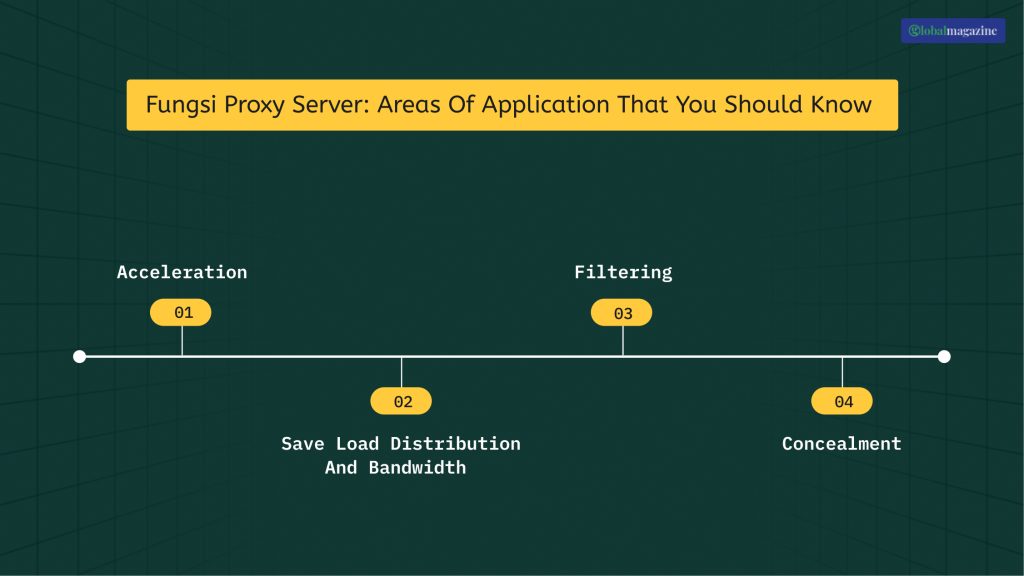
Here are some of the major areas of application when it comes to proxy servers that you should know about:
1. Acceleration
A cache stores data that is frequently used so that it can be retrieved quickly.
Caching allows a proxy server to deliver a faster response when it is asked for the same data (e.g. websites) or repetitive requests again.
Therefore, it saves the use of bandwidth, and the response time becomes shorter.
2. Save Load Distribution And Bandwidth
Besides, a proxy server is capable of adjusting the bandwidth and load balancing. This can be done through the distribution of bandwidth to the clients. Thus, the resources are being used at their best.
For instance, if you block one or two clients from using the network, the transmission capacity is not being used. In case there are several lines or interfaces, the proxy makes sure that the load is divided equally.
3. Filtering
In fact, a proxy server is a useful tool for network administrators to have more control over local data traffic on the network.
Additionally, administrators can block certain websites, or they can be influenced by white and black lists.
Hence, the local users behind the proxy will not be given access to those sites. When visiting a blocked site, you could be informed that the requested site is not available.
4. Concealment
Finally, there’s concealment. In such cases, the client sends the request to the proxy server. It handles the request and then forwards it to the router, indicating the IP address of the proxy server.
Eventually, the router sends the request to the Internet. The client’s real IP address is not revealed, and the client’s origin can be somewhat concealed.